Technology has become the foundation of modern business operations. From communication and cybersecurity to cloud computing and customer service, organizations depend on reliable IT systems to remain productive and competitive. One of the biggest decisions businesses face is whether to manage technology internally or partner with an external service provider. The debate surrounding Managed IT Services vs In-House IT continues to grow as companies seek the most efficient and cost-effective way to support their IT infrastructure.
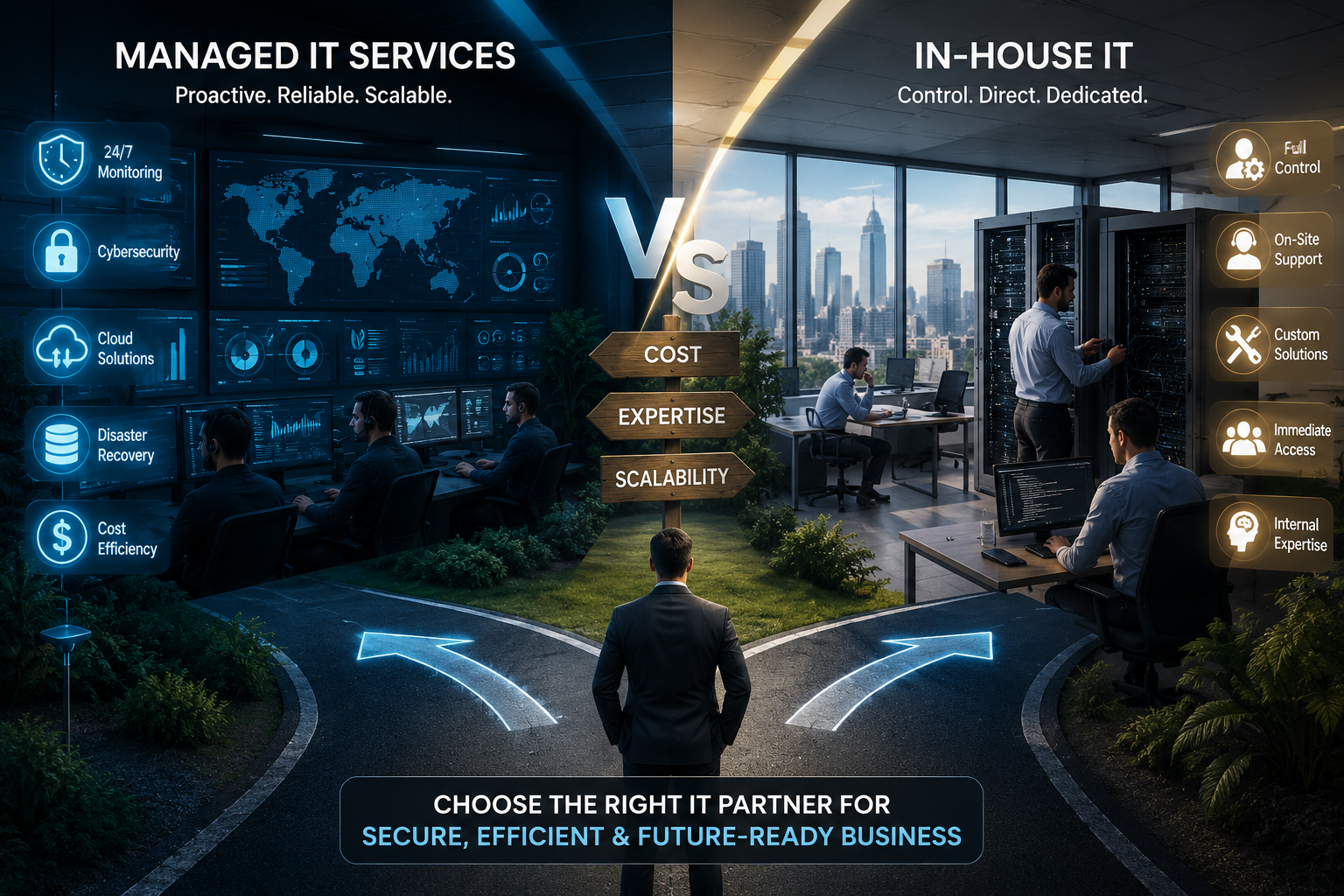
Both approaches offer unique advantages. An in-house IT department provides direct control over daily technology operations, while managed IT services deliver expert support, proactive monitoring, and predictable costs through an external provider. Choosing the right model depends on business size, budget, security requirements, and long-term growth plans.
This guide explores Managed IT Services vs In-House IT, comparing their features, benefits, challenges, and ideal use cases to help businesses make informed technology decisions in 2026.
What Are Managed IT Services?
Managed IT Services refer to technology support provided by a third-party company, commonly known as a Managed Service Provider (MSP).
Instead of hiring a full internal IT team, businesses outsource technology management to specialists who monitor networks, maintain servers, secure cloud environments, perform software updates, manage backups, and provide technical support.
Many MSPs also offer cybersecurity monitoring, disaster recovery planning, cloud migration, compliance assistance, and strategic IT consulting.
This proactive approach helps businesses reduce downtime while improving operational efficiency.
What Is In-House IT?
An in-house IT department consists of employees who work directly for the organization.
These professionals manage company hardware, software, networks, cybersecurity, user support, and technology planning from within the business.
Because they work closely with other departments, internal IT teams often develop a deep understanding of business processes, company culture, and organizational goals.
Many medium-sized and large enterprises continue relying on internal IT departments for complete operational control.
Managed IT Services vs In-House IT: The Main Difference
The primary difference between Managed IT Services vs In-House IT is how technology support is delivered.
Managed IT Services rely on external specialists who remotely monitor and manage business systems under a service agreement.
In-house IT depends on internal employees responsible for maintaining the organization’s technology infrastructure.
While managed services provide broad technical expertise and predictable pricing, internal teams offer direct oversight and immediate on-site support.
Cost Comparison
Cost is often one of the biggest deciding factors.
Building an internal IT department involves salaries, employee benefits, recruitment, office space, training, certifications, and hardware investments.
Managed IT Services usually operate on a monthly subscription model with predictable pricing.
Businesses gain access to experienced professionals without the expense of maintaining a full-time IT department.
For many small and medium-sized organizations, outsourcing IT support is often more affordable.
Technical Expertise
Technology evolves rapidly.
Managed IT providers employ specialists in cybersecurity, cloud computing, networking, virtualization, compliance, backup solutions, and disaster recovery.
Because MSPs support multiple organizations across different industries, they maintain broad technical experience and stay updated with emerging technologies.
Internal IT teams may possess strong company-specific knowledge but often have fewer specialists available for highly technical projects.
Security and Compliance
Cybersecurity remains a top priority in 2026.
Managed IT providers typically offer continuous threat monitoring, vulnerability management, endpoint protection, security awareness training, and compliance support.
Many providers also maintain dedicated Security Operations Centers that monitor systems around the clock.
Internal IT departments can provide strong security as well, but achieving similar capabilities often requires additional personnel, software, and ongoing investment.
Scalability
Business growth often creates new technology demands.
Managed IT Services make scaling infrastructure relatively simple by providing additional resources, cloud services, and technical expertise as needed.
Organizations expanding into new locations or adopting hybrid work environments often benefit from this flexibility.
In-house IT departments may require additional hiring and infrastructure investments before supporting business expansion.
Response Time
Quick technical support minimizes downtime.
Internal IT staff working on-site can often respond immediately to hardware issues, office equipment failures, and employee requests.
Managed IT providers frequently offer remote monitoring and 24/7 support, allowing many problems to be identified and resolved before users even notice them.
The ideal solution depends on the organization’s operational requirements.
Control and Customization
Some businesses prefer complete control over technology decisions.
Internal IT teams allow organizations to directly manage priorities, projects, security policies, and infrastructure changes.
Managed IT providers generally operate according to service-level agreements while still offering customizable service packages.
Organizations requiring highly specialized systems may prefer internal management, while standard business environments often benefit from outsourced expertise.
Which Businesses Should Choose Managed IT Services?
Managed IT Services are ideal for organizations that:
- Want predictable monthly IT costs.
- Need access to specialized expertise.
- Operate with limited internal IT resources.
- Require 24/7 monitoring.
- Plan to migrate to cloud environments.
- Need scalable technology support.
Startups and growing businesses frequently choose managed services because they provide enterprise-level support without large staffing costs.
Which Businesses Should Choose In-House IT?
An internal IT department may be more appropriate for organizations that:
- Require constant on-site support.
- Manage highly customized business applications.
- Operate complex enterprise environments.
- Need direct control over technology operations.
- Have sufficient budgets for dedicated IT staffing.
- Maintain strict internal security policies.
Large enterprises often combine internal expertise with specialized external support.
Can Businesses Use a Hybrid Approach?
Yes.
Many organizations successfully combine Managed IT Services with an internal IT team.
Internal employees focus on strategic projects, user support, and company-specific operations, while managed service providers handle cybersecurity, cloud management, backups, disaster recovery, and infrastructure monitoring.
This hybrid model offers both flexibility and access to specialized expertise.
Best Practices for Choosing the Right IT Model
Before selecting an IT strategy, businesses should evaluate their technology requirements, available budget, compliance obligations, cybersecurity risks, growth plans, and internal expertise.
Organizations should also assess expected response times, service availability, vendor reputation, scalability, and long-term business objectives.
Regular technology assessments help ensure the chosen model continues meeting business needs as operations evolve.
The Future of IT Services
Cloud computing, artificial intelligence, automation, and cybersecurity are transforming the IT services industry.
Managed service providers increasingly use AI-powered monitoring, predictive maintenance, automated threat detection, and cloud-native management platforms to improve service quality.
Meanwhile, internal IT departments are shifting toward strategic digital transformation initiatives rather than routine maintenance tasks.
Businesses that combine automation with expert IT support will be better positioned to remain competitive.
To learn more about IT infrastructure best practices and technology management, visit the Gartner Information Technology.