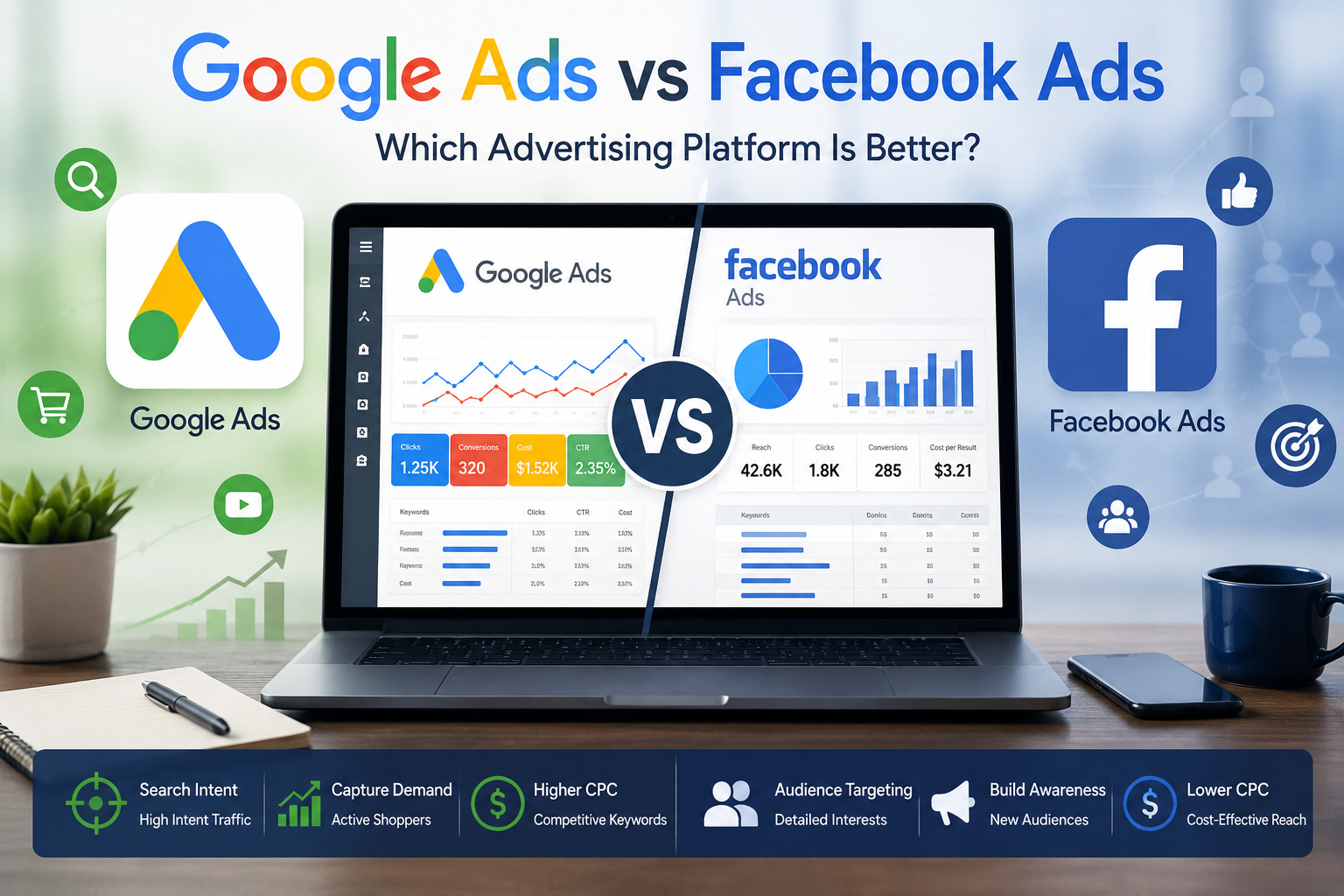
Online advertising has become one of the most effective ways for businesses to reach customers, generate leads, and increase sales. Whether you operate a small local business or a large enterprise, choosing the right advertising platform can significantly impact your marketing success. Among the most popular platforms, the comparison of Google Ads vs Facebook Ads continues to be one of the most common questions for marketers in 2026.
Both platforms offer powerful advertising solutions, but they serve different purposes. Google Ads helps businesses reach users who are actively searching for products or services, while Facebook Ads focuses on discovering potential customers through detailed audience targeting. Understanding the strengths and limitations of each platform allows businesses to make better marketing decisions and maximize their return on investment.
This guide explains Google Ads vs Facebook Ads, comparing their features, targeting capabilities, pricing, benefits, and ideal use cases to help you determine which platform best suits your business goals.
What Is Google Ads?
Google Ads is Google’s online advertising platform that allows businesses to display advertisements across Google Search, YouTube, Google Maps, Gmail, and millions of partner websites through the Google Display Network.
The platform primarily targets users based on search intent. When people search for specific products, services, or information, Google Ads displays relevant advertisements that match their search queries.
Because users are actively looking for solutions, Google Ads often delivers highly qualified traffic with strong purchase intent.
What Is Facebook Ads?
Facebook Ads, now part of the Meta advertising platform, enables businesses to advertise across Facebook, Instagram, Messenger, and the Meta Audience Network.
Unlike search advertising, Facebook Ads focuses on audience targeting rather than search intent. Businesses can reach potential customers based on demographics, interests, online behavior, education, job titles, locations, and purchasing habits.
This approach helps businesses introduce products and services to people who may not yet be actively searching for them.
Google Ads vs Facebook Ads: The Main Difference
The biggest difference between Google Ads vs Facebook Ads lies in user intent.
Google Ads targets people who already have a need and are searching for answers. For example, someone searching for “best accounting software” is likely interested in making a purchase.
Facebook Ads reaches users while they browse social media. Instead of responding to an active search, advertisements appear based on audience interests and behavior.
Businesses looking for immediate customer demand often prefer Google Ads, while companies focused on brand awareness frequently benefit from Facebook Ads.
Audience Targeting
Both advertising platforms provide advanced targeting options.
Google Ads primarily targets users through keywords, search behavior, geographic location, devices, language, and audience segments.
Facebook Ads offers highly detailed audience targeting using age, gender, interests, hobbies, shopping behavior, education, income levels, life events, and custom audiences.
Businesses seeking highly personalized audience segmentation often appreciate Facebook Ads’ extensive targeting capabilities.
Advertising Formats
Google Ads supports multiple advertising formats, including:
- Search ads
- Display ads
- Shopping ads
- Video ads
- App promotion ads
- Performance Max campaigns
Facebook Ads also provides various advertising formats, such as:
- Image ads
- Video ads
- Carousel ads
- Collection ads
- Stories ads
- Reels ads
- Lead generation ads
Both platforms offer flexible creative options suitable for different marketing objectives.
Cost Comparison
Advertising costs vary depending on industry competition, audience targeting, and campaign objectives.
Google Ads often has higher cost-per-click because advertisers compete for high-value search keywords.
Facebook Ads generally offers lower advertising costs for brand awareness and audience engagement campaigns.
However, lower advertising costs do not always result in higher conversions. Campaign performance depends on strategy, audience quality, and advertisement relevance.
Lead Generation
Lead generation remains a priority for many businesses.
Google Ads performs exceptionally well for businesses offering services that customers actively search for, including legal services, healthcare, home improvement, software, and consulting.
Facebook Ads generates strong results for businesses promoting consumer products, online courses, events, fashion, fitness, and lifestyle brands through engaging visual content.
Choosing the right platform depends largely on customer buying behavior.
Brand Awareness
Facebook Ads has become one of the strongest platforms for building brand awareness.
Businesses can introduce products to new audiences through engaging images, videos, stories, and interactive advertisements.
Google Ads contributes to brand visibility primarily by appearing in search results when users seek relevant products or services.
Companies launching new products often combine both platforms for maximum visibility.
Analytics and Reporting
Both platforms provide detailed performance analytics.
Google Ads offers comprehensive reporting on impressions, clicks, keyword performance, conversions, search terms, and return on ad spend.
Facebook Ads provides valuable insights into audience engagement, demographics, reach, click-through rates, video performance, conversions, and customer interactions.
These reporting tools help marketers continuously optimize campaign performance.
Which Businesses Should Choose Google Ads?
Google Ads is an excellent option for businesses that:
- Sell products people actively search for.
- Want immediate website traffic.
- Focus on lead generation.
- Operate local service businesses.
- Require measurable search advertising performance.
- Need high-intent customer acquisition.
Businesses with clear customer search demand often achieve strong conversion rates through Google Ads.
Which Businesses Should Choose Facebook Ads?
Facebook Ads is ideal for businesses that:
- Build brand awareness.
- Promote visually appealing products.
- Target specific customer interests.
- Sell directly to consumers.
- Run seasonal promotions.
- Generate social engagement.
Brands focusing on storytelling and customer relationships often benefit from Facebook’s highly visual advertising environment.
Can Businesses Use Both Platforms?
Absolutely.
Many successful businesses combine Google Ads and Facebook Ads within a single digital marketing strategy.
Google Ads captures customers actively searching for solutions, while Facebook Ads introduces products to new audiences and strengthens brand recognition.
Using both platforms together often creates a complete marketing funnel that increases customer acquisition and improves long-term business growth.
Best Practices for Successful Advertising
Regardless of which platform you choose, successful advertising requires careful planning.
Define clear campaign objectives before launching advertisements. Create compelling headlines, engaging visuals, and persuasive calls to action. Continuously test different audiences, monitor campaign performance, and optimize budgets based on measurable results.
Businesses should also install conversion tracking, analyze customer behavior, and regularly update advertising creatives to maintain strong campaign performance.
Consistent optimization is often the key to long-term advertising success.
To learn more about online advertising best practices, visit the Google Ads Help Center.